

heatwave season
The world aslant

On a grey morning in March I was pushed over in Notre Dame. It was my first proper time in Paris. Last time in the city I’d been a child longing for chocolate but every chocolate shop we passed was closed, it was strange, it was a holiday maybe and maybe 2004. This time I’d made an itinerary months in advance, arranged museum passes, worked out the Metro route and the average time for the queue. I had saved pictures of the cathedral to my ‘travel’ Pinterest board, looked at side-by-side comparisons from before the fire and the restoration. When we entered my eyes took moments to adjust, we were part of a pilgrimage of tourists with iPhones which all rose in tandem, as if to make the sign of the cross. The rose window at the end of the cathedral glimmered purple, like a deep pool in a deep wood. We raised our iPhones to its glow.
I do not remember being pushed; I only remember falling. I do not even remember falling. I remember the pool in my own stomach opening, rending, a split second in which everything solid slid away into its depths. Like breathing in as you fall into water, the rush of it reaching up to claim me, strangeness of choking on something so insubstantial. I felt the scream in my throat but did not hear it, although people were looking, or moving away, perhaps thinking of terrorist attacks, or insanity. And then I was upright again, flailing, a girl with her hands on my shoulders speaking French, then breaking into broken English, I’m sorry, I’m sorry my brother is not well. He was a teenager, his eyes wild as horses’ behind her. I know, I know it’s okay, I said, and I think, embarrassed, very British, I’m sorry too,
In Notre Dame you move in a loop around the pews and the chancel. Reliquaries and tombstones nestle in the arches of the cathedral. There are disjunctures where modern art has replaced lost treasures. Everything is just a bit too clean. Bones burned white. Deep in the church’s belly a priest was saying mass, we tourists were held in a bottleneck at the side of the altar before we could cross, complete the loop. I kept trying to glimpse the boy and his sister. Not to keep them away or because I wished to speak to them again — I did not — but to make sure they were real. It was Maundy Thursday or Good Friday. I cannot remember. B asked me if I wanted to light a candle because in churches I always want to light a candle and I said yes and my hands were shaking. There were tears rolling down my face and I felt like wax. They were not tears of sadness or self-pity or shame. They were not tears with meaning beyond that of my animal body, intruding. I could not be part of this crowd. How could I be — I did not feel I was the same species as the others. Something had fallen out of me when I fell. The pool in me had opened up and closed over and swallowed it. My eyes had jolted sideways in my head. I was seeing the world aslant and it was violent. Everyone was a stranger. Everyone was scared. The candle was meant to mean something. But it didn’t.
In Rachel Cusk’s short story-slash-essay ‘The Stuntman’, the writer-slash-narrator describes being pushed over by a woman in a Paris street. Connecting the experience to other experiences in her ‘female’ life, such as childbirth, Cusk reflects that she ‘had generally attributed those female experiences to an alternate or double self whose role it was to absorb and confine them so that they played no part in the ongoing story of life. Like a kind of stuntman, this alternate self took the actual risks in the creation of a fictional being whose exposure to danger was supposedly fundamental to its identity. But the violence and the unexpectedness of the incident in the street had caught my stuntman unawares’.
Writing and rewriting the first line of my own experience, so strangely similar to Cusk’s, down to the city in which it occurred, I have debated passive or active voice, the choice of verb. The number of nouns, how they might apportion blame. On a grey morning in March a boy pushed me in Notre Dame. In March I was pushed in Notre Dame. I was shoved. In March I was attacked in Notre Dame. Attacked is the word Cusk uses in ‘The Stuntman’. It is an accurate word, more accurate in her case than in what happened to me, but it is a word which drips with its own violence. It punches itself forwards with plosives, those double t’s like raised fists, the kick of the k, and drops to the ground, rolling. It is a word with bared teeth. The boy who shoved me did not have bared teeth. He was much more scared than I was, and I was the one who screamed. Like Cusk, my stuntman was caught unaware, off guard. But my assailant did not even have a stuntman to stand in for him.
When Cusk-slash-her-narrator looks back at own experience, she reflects that her desire to understand the incident ‘gradually gave way to the knowledge that what I was experiencing was, in fact, the defeat of representation by violence’. This puncturing of narrative, this moment of realisation that maybe narrative is all there is, that beyond is the void, and nothing but the void, which might be madness but might be a wild new way of seeing, is what I have always read in Cusk’s work. Her insight seems to be that reality is mere representation, or rather that true reality itself is hidden beneath a layer of representation which can only be punctuated by moments of violence.
Not that the boy who pushed me had intended violence, but that in him pushing me, or maybe just in the fact of me being pushed, something had been revealed about the fabric of society, something fundamental which already lay behind the both of us.
Lately the unreality of the world has been alarming. Reality intruding into unreality. Or rather, reality revealing unreality — the facade of society, the facade that is society. I walk down the main road adjoining my street in the city where I live with sweat peeling down my back. Every week another vape shop or American candy store seems to open, as inexplicably as the flying ants spontaneously generating on the burning pavement. Online, everything looks worse, feels worse, from the products I am promoted to the body shape I am told I should have. The digital realm where I spend much of my time takes on the quality of cheap, single use plastic. And the online now bleeds off, a strange reversal. The posters outside the local cafes have all been replaced with AI menus; identical, disgusting looking smoothies and panini and Dubai Chocolate crepes. At least the familiar strangers of the city remain the same. I see the library regulars and gym-goers out of context in the summer and uncomfortably catch their eyes. I wonder too if the silent, scary man who protests by the shopping centre, or the buskers I have known the voices of for five plus years, now recognise me too.
It has been hot, this summer, in the country I live in. So hot that to write that feels redundant. I can feel it in the sweaty soles of my sneakers and the frayed palms of my hands as I type. July was the second hottest month ever recorded in the UK, behind only July 2006, a year when such events were still infrequent enough and I was still small enough that ‘heatwave’ meant novelty, meant inflatable paddling pools and spinning around under the garden hose with my dad, at least until the hosepipe ban kicked in. Today’s children will never know such novelty. It is early August and the country has already suffered four heatwaves, the sort of record breaking temperatures which mean even the usually uncritical headlines reporting those temperatures have shifted from bodies on the beach to bodies in the morgue. It is so hot that wildfires have scorched our green land, and decimated our neighbours across the channel. That whole ecosystems are burning alive, and cannot be revived. It is so hot that each train I have taken has been delayed or cancelled, tracks screaming bright in the midday sun, signals melting. It is so hot that a reading I attended earlier this year literally went up in smoke, black clouds from an urban fire billowing across the rooftops, my friends and I running onto an overground train pressing headscarfs and tote bags to our faces, coughing, the smoke pouring into the carriage behind us. Holding our iPhones to the glow. That stupid Tweet: ‘Climate change will manifest as a series of disasters viewed through phones with footage that gets closer and closer to where you live until you’re the one filming it’.
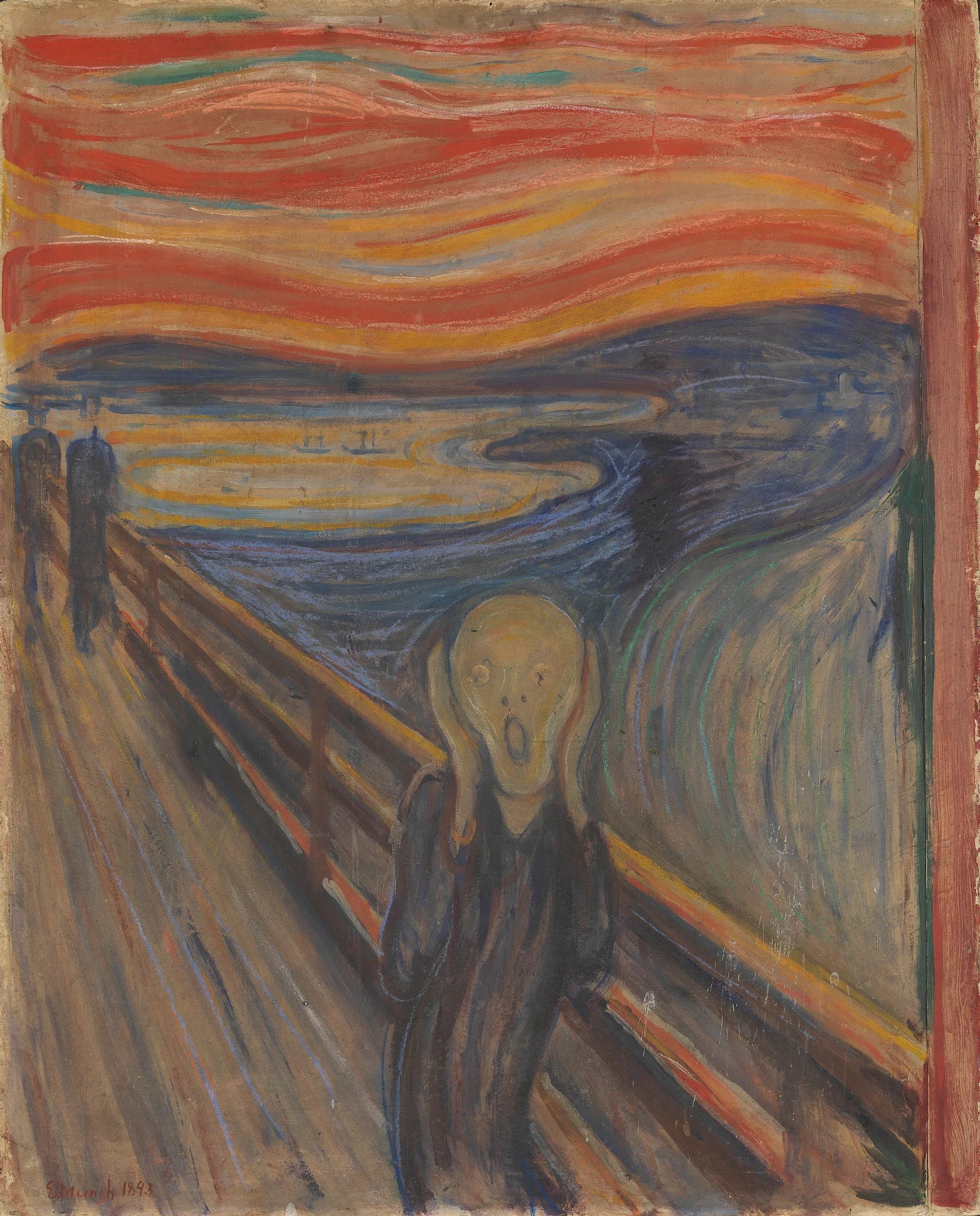
The infrastructure of my world melting. No wonder then the unreality, the sense of a curtain slipping, not yet moved back into place, or stitches ripping at the seams. Skull buckling while the face still smiles. No wonder that my stuntman seems to have left me, perhaps back in March, on the floor of Notre Dame, and failed to return. I have felt ill and exhausted and lacklustre. I have felt sick of my own ‘I’. I walk down the main road adjoining my street in the city where I live and I feel Edvard Munch’s ‘infinite scream passing through nature’ ripping through me. Can the others feel it or is it just me? Which is worse?
In her essay on the scorching Santa Anas of Los Angeles, Joan Didion links the winds to headaches, nausea, and violent death. The Santa Anas and the wildfires they cause, she says, reveal ‘Los Angeles’s deepest image of itself’. ‘Los Angeles weather is the weather of catastrophe, of apocalypse’, Didion writes: ‘the violence and the unpredictability of the Santa Ana affect the entire quality of life in Los Angeles, accentuate its impermanence, its unreliability. The winds shows us how close to the edge we are’. The winds do what Cusk’s encounter in Paris does to her, on a city-wide scale. And this is what the world is now experiencing, the violence and unpredictability and impermanence of human life ripping through us like the winds, writ large across the globe. Narratives collapsing. In the country where I live, we are not prepared. Our identity is built on predictability, on grey rain and summer’s like gravy. Grey rain a blanket which muffles but does not stifle the facts beneath it. So here we do not have our stuntman intact. We have only excuses and denial and ‘remember the heatwave of ’76?’.
And beneath all of that we have fear. The world gone aslant somehow, as if we woke up on the wrong side of the bed, one too many times. As if the wind finally changed, and left each of us with a different face. Every one of us a stranger. Every one of us scared.
This is the first thing I’ve written for Substack for a long time. Hello! I’m still here! Persevering through the horrors (genuinely). I don’t know if this works as an essay. Or if anyone is even still reading twenty first century demoniac to care. Let me know if you are.
H.
Missed your words! Really enjoyed this and glad you were caught before completing the fall.
love this + so glad to read your words again